Kaedim is an AI 3D asset platform that turns 2D concept art into game-ready models, used in production at EA, Activision, Azra Games and more.
Project
Kaedim 3D
Year
2023
3D ASSETS
OVERHAUL
SAAS

OVERVIEW
Project
Platform
Company
Kaedim 3D
Year
2023
What we were building
Kaedim is an AI 3D asset platform that turns 2D concept art into game-ready models, used in production at EA, Activision, Riot, and Roblox. On a three-person design team I led the work end to end: the 2D-to-3D generation flow, the asset library, and the human-in-the-loop review interface, plus the design system from scratch. The dashboard I designed became the product behind Kaedim's $15M Series A from a16z Games.

THE PROBLEM
3D asset creation was a production bottleneck no studio could afford.
From AAA studios to indie teams, 3D artists were buried under impossible timelines. A single character could take eight weeks, and scaling that output meant ballooning headcount. Kaedim's AI shifted the math. My job was to design the product that made it credible.
8 weeks to make one character
Traditional 3D workflows were too slow for live-service games. Studios needed alot of assets in the time it took to model one.
Headcount couldn't scale production
Hiring more 3D artists wasn't sustainable. Studios needed 10× the volume without 10× the cost.
AI tools lacked production quality
Existing AI 3D tools output broken meshes, missing UVs, and n-gon topology. Nothing was game-ready out of the box.
Pipeline integration was fragmented
Blender, Unity, Unreal and proprietary engines created coordination overhead that killed momentum mid- production.
Goals & Design Criteria
Ship a product studios could actually trust.
Kaedim's AI was powerful on its own. The interface had to make studios believe that before they had any proof. Three pillars drove every design decision.
Speed Without Sacrifice
Design a workflow where studios get production-ready 3D assets in minutes, not weeks, without compromising art style or technical quality.
PERFORMANCE UX
Visibility Into the Pipeline
Give art directors real-time visibility into every asset's status, generation, review, refinement, and export, in one dashboard.
STATUS TRANSPARENCY
Frictionless Engine Integration
One-click export to Unity, Unreal, Blender, and NVIDIA Omniverse. Assets land in the right format for the right pipeline, automatically.
PIPELINE INTEGRATION

The Platform
One dashboard. Every asset, every status, every pipeline.
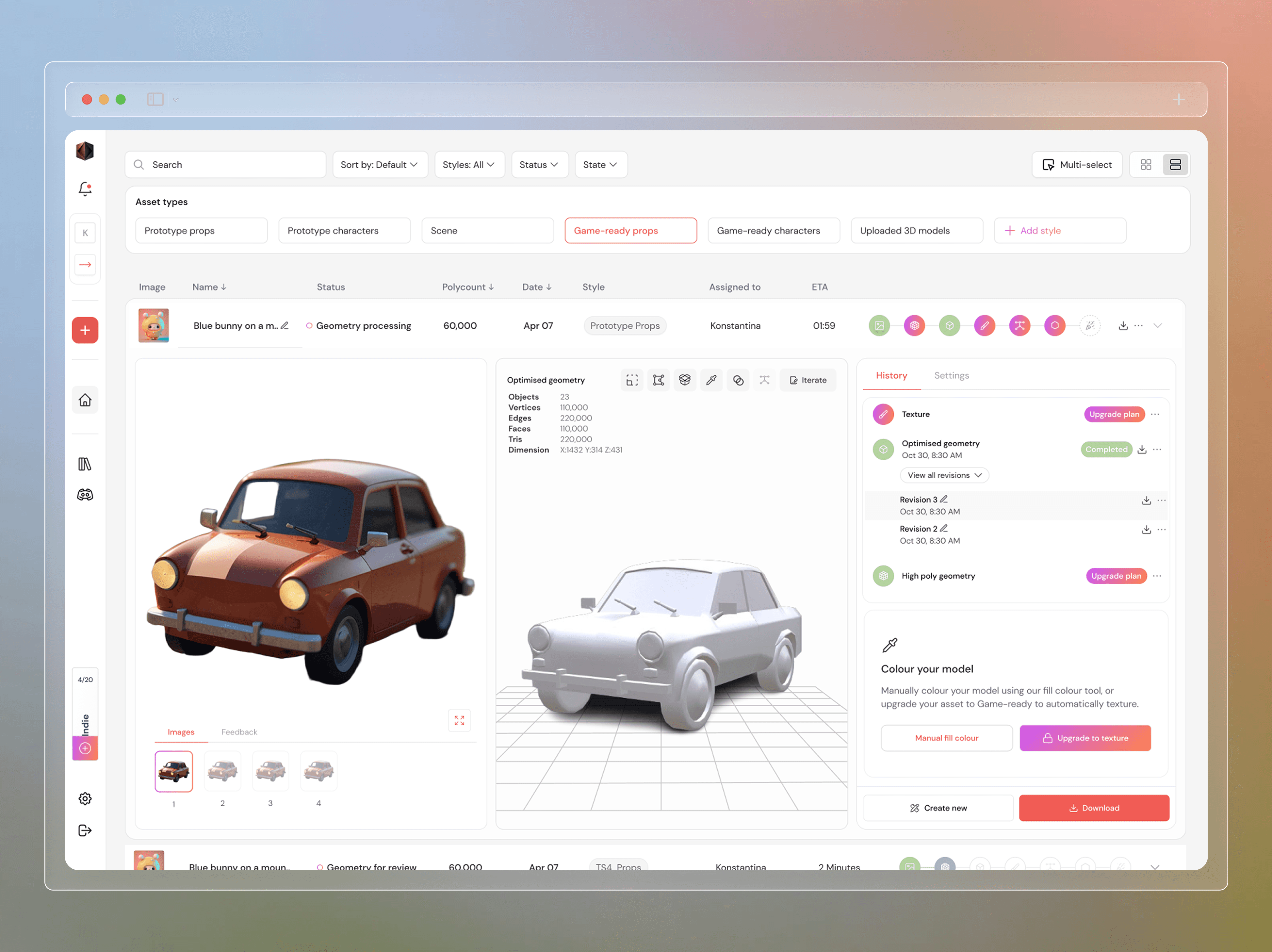
The Kaedim dashboard is where game studios manage their entire 3D asset pipeline, from submitting concept art to downloading production-ready models. I designed every state, every edge case, and every empty screen.
Real-time generation queue
Live status for every asset in progress, queued, generating, in review, complete, or failed.
Multi-collection asset library
Folder-based collections with filters by quality tier, style, polycount, and export status.
Studio & team management
Workspace roles, credit usage, and per-studio pipeline settings for multi-team organisations.
CORE FEATURES
Every surface of the product, from first upload to final export.
I owned the end-to-end design across four critical surfaces: the creation flow, the 3D editor, asset review, and team management.
01 · Creation Screen
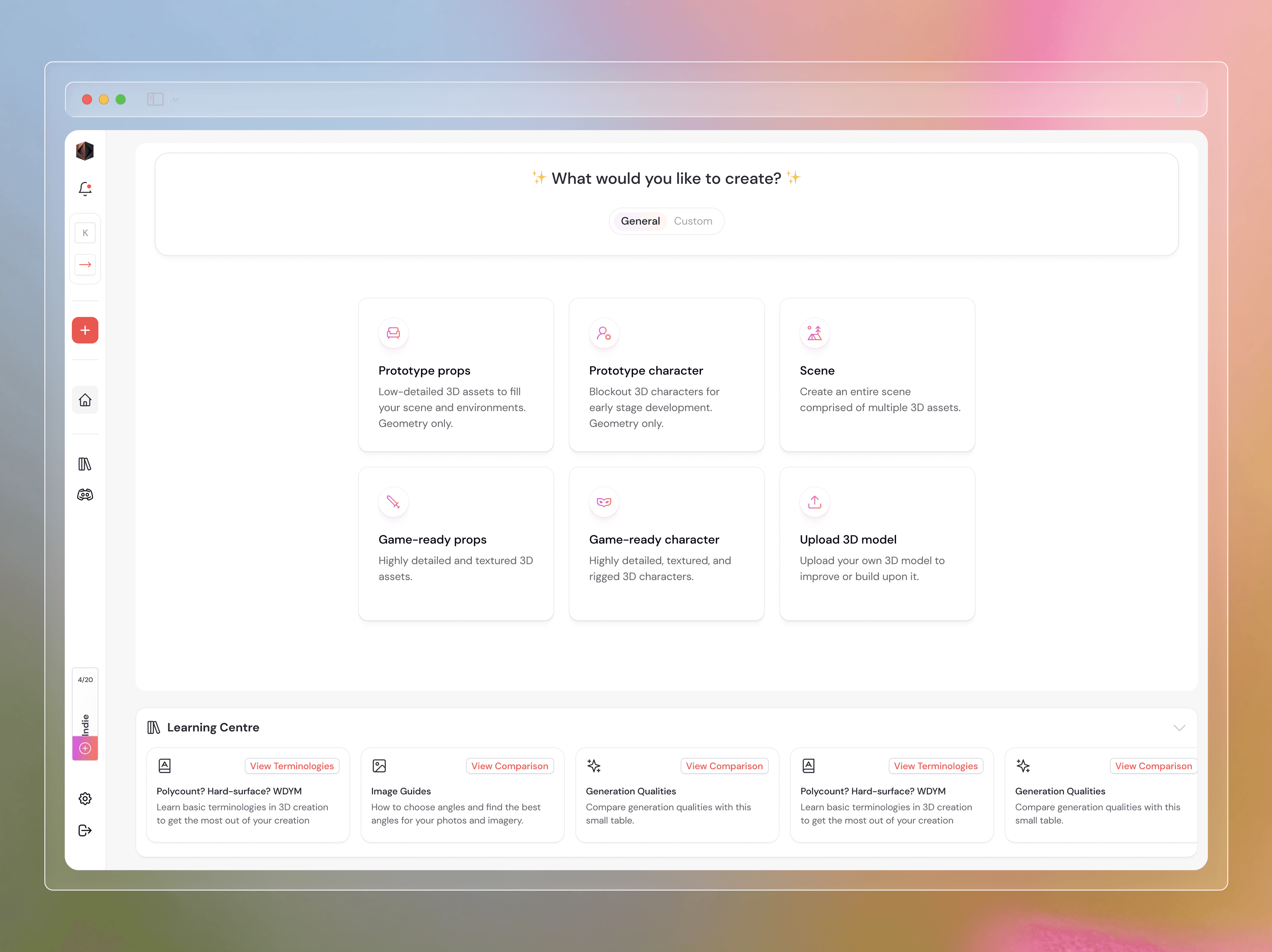
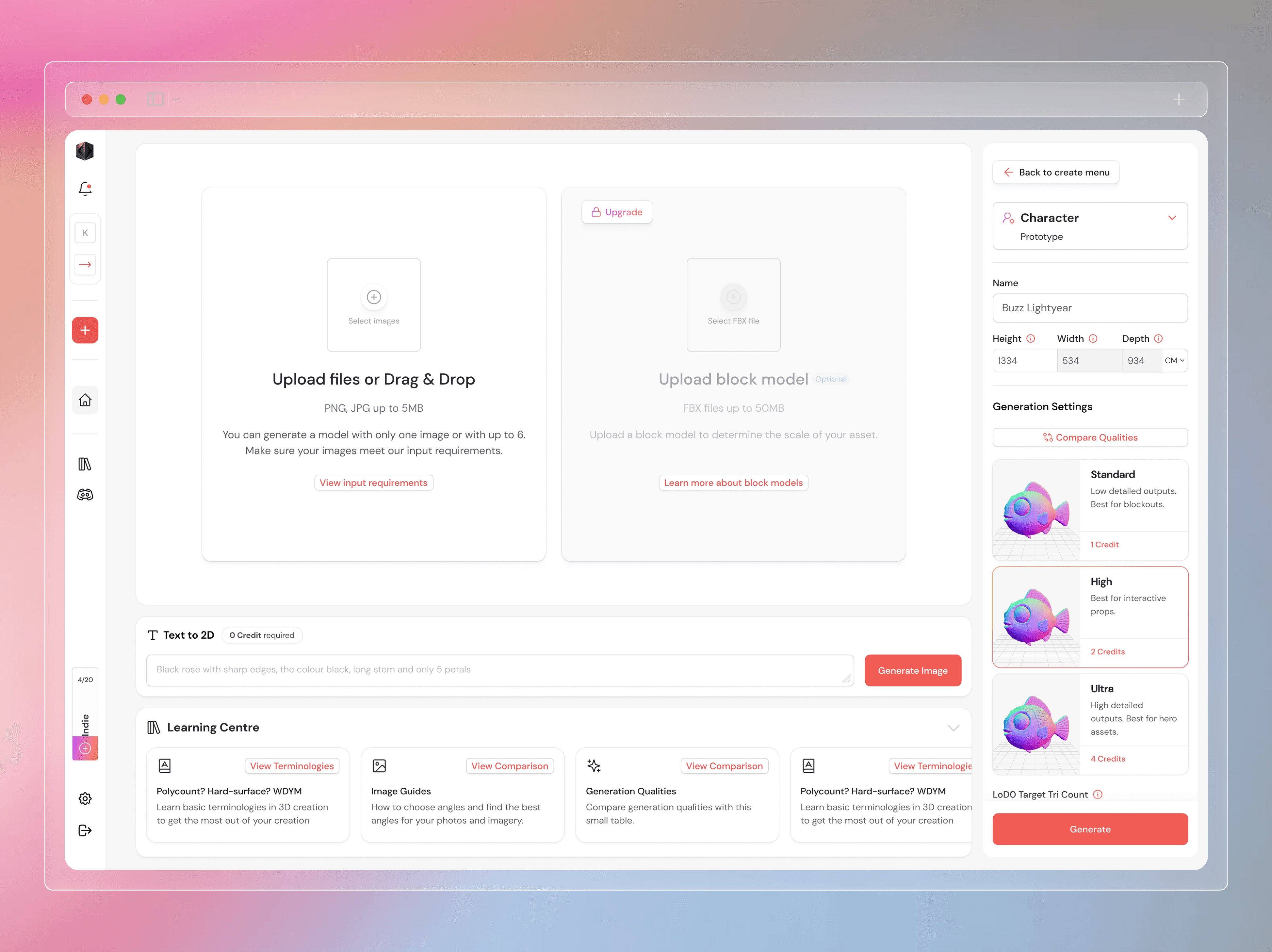
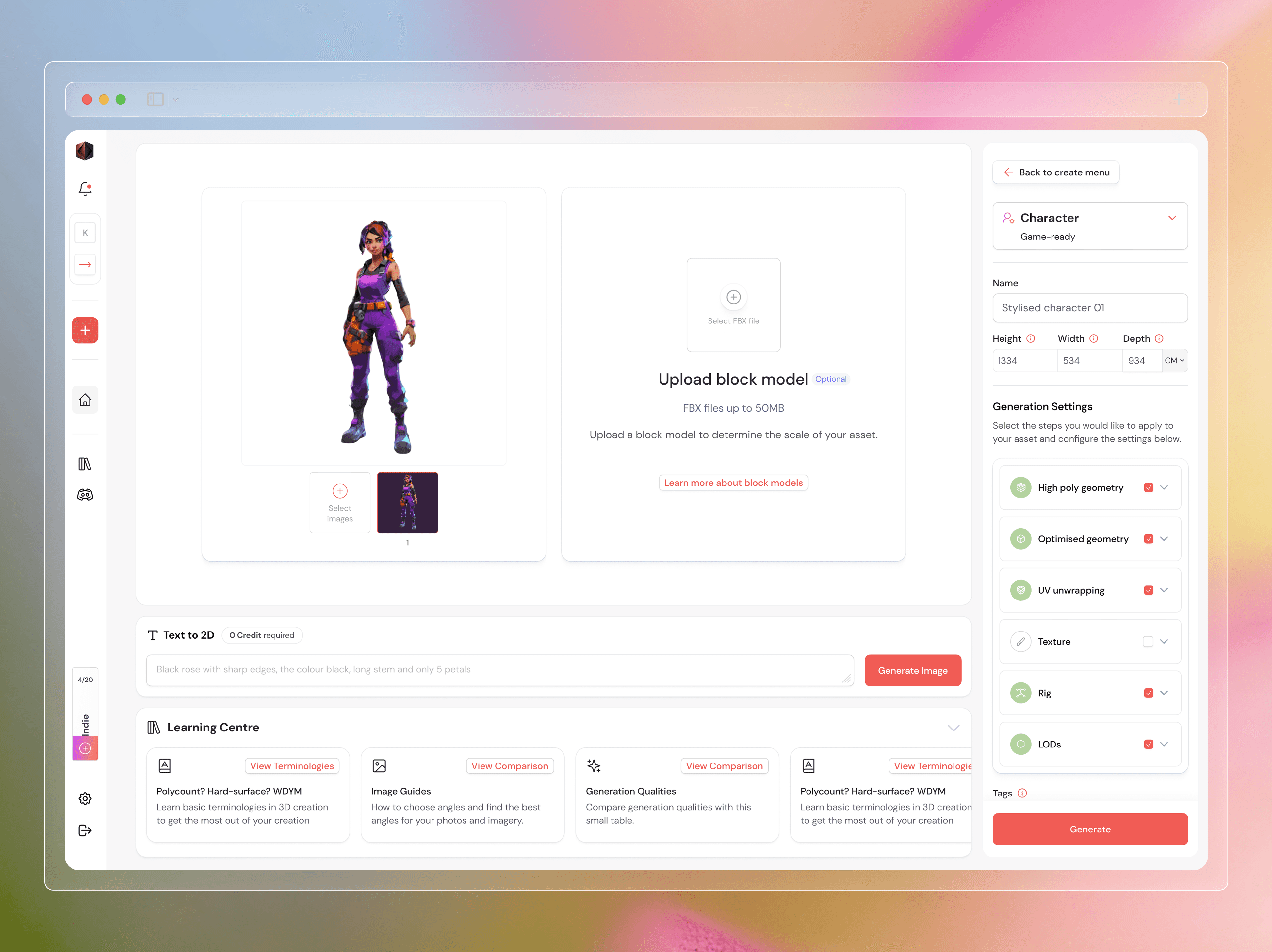
From concept art to 3D model, without touching a modelling tool.
I designed the full creation flow: upload 2D reference images, select asset type, configure quality tier and dimensions, then submit. The UI needed to feel precise for AAA art directors while remaining approachable for indie teams with no 3D background.
Multi-image upload with drag-and-drop and reference stacking
Quality tier selection: Standard, High, Ultra, with credit cost preview
Text-to-2D prompt generation for reference-free workflows
UPLOAD UX
AI SUBMISSION
QUALITY CONFIG
02 · 3D Editor
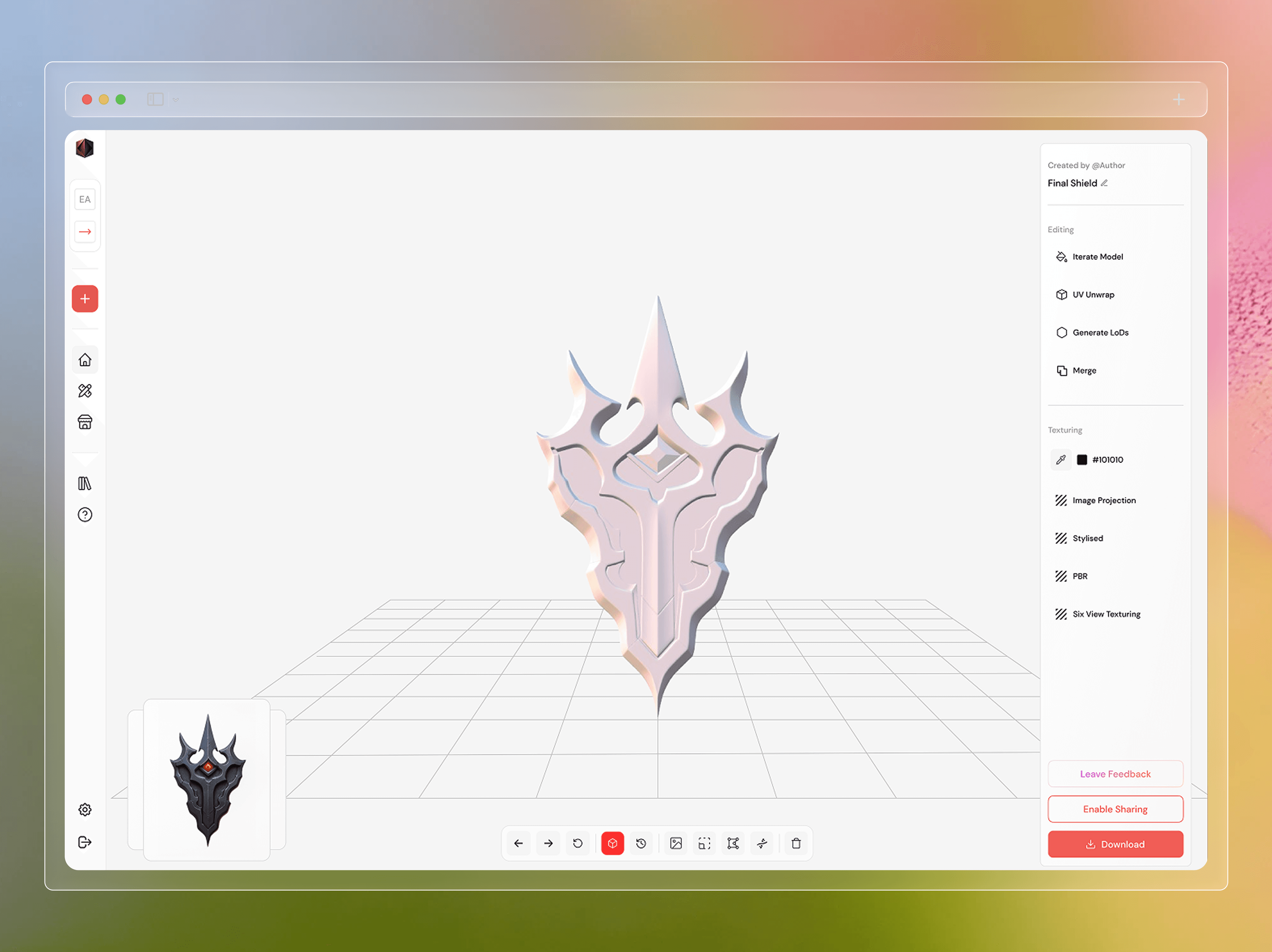
Post-generation refinement: iterate, texture, and prep for export.
Once a model is generated, studios need to refine it without leaving the platform. I designed the 3D Studio editor: orbit controls, texturing tools, UV unwrap triggers, and LoD generation, all in one browser-based workspace.
Interactive 3D viewport with orbit, zoom, and ground plane
Texturing panel: PBR, stylised, image projection, six-view bake
One-click UV unwrap, LoD generation, and mesh merge
3D VIEWPORT
TEXTURING
MESH TOOLS
03 · Asset Details Modal
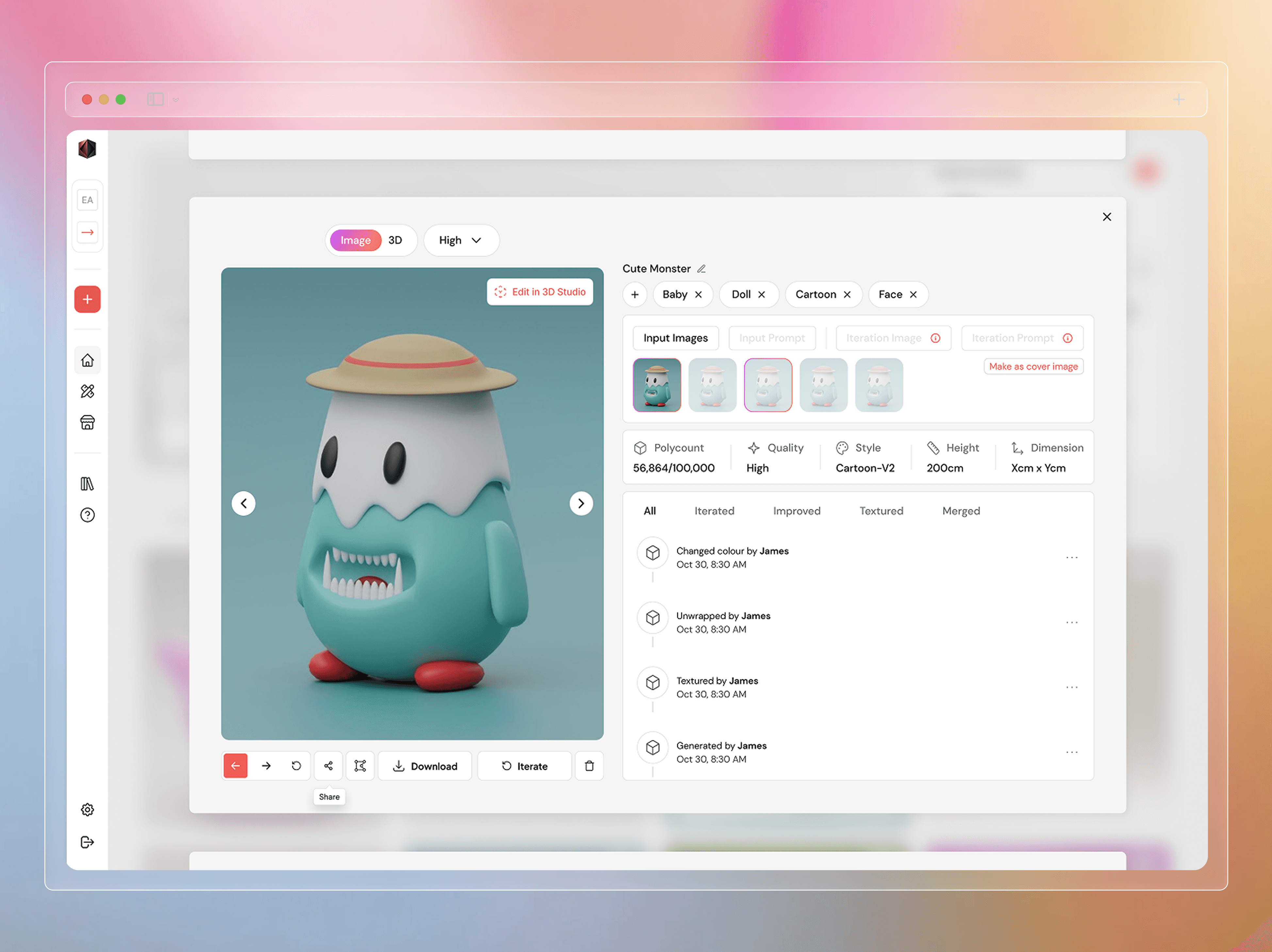
Full asset history, metadata, and revision control, in one modal.
Art directors needed to inspect every version of an asset without leaving the dashboard. I designed the Asset Details modal: version history, iteration timeline, polycount and quality metadata, and a direct path to the 3D editor or export panel.
Image / 3D view toggle with generation iteration thumbnails
Full audit log: generated, textured, unwrapped, colour-changed
Polycount, quality tier, height, and dimension metadata at a glance
VERSION HISTORY
METADATA
REVIEW UX
04 · Team Workspace

Multi-studio access control, built for how game companies actually work.
Large studios run multiple projects simultaneously across different teams. I designed the Workspace layer: member roles, per-studio permissions, invitation flows, and credit allocation, the infrastructure that lets enterprise accounts operate at scale.
Guest, Editor, and Admin roles scoped per studio project
Invite flow with pending state, role assignment, and bulk management
Member table with search, filter by studio, role, and designation
ACCESS CONTROL
PERMISSIONS
ENTERPRISE UX

The Process
Six months of research, system building, and relentless iteration.
Started with gamers, not assumptions. Four archetypes, five research methods. Every decision traceable back to something a real gamer told us.
01
Phase 01 · Discovery
Studio Embeds & Pain Mapping
Spent time with art directors at AAA and indie studios, mapping existing workflows, where hours were lost, where context switched, where trust broke down.
USER INTERVIEWS
WORFLOW MAPPING
02
Phase 02 · Definition
Translating AI
Capability into UX
Worked with engineers to
understand what the AI pipeline could and couldn't do, then designed UX that communicated system state clearly, without overpromising.
SYSTEMS MAPPING
EDGE CASES
03
Phase 03 · Design
Dashboard, Library & Review System
Figma explorations covering the full surface: zero states, generation in progress, error handling, review annotation layer, and export panel. 40+ screens shipped.
WIREFRAMES
DESIGN SYSTEM
04
Phase 04 · Launch
GDC 2024 & A16Z
Series A
The redesigned platform
launched at GDC 2024
alongside the A16Z Series A. I created the live demo experience used at the booth, and the product it demoed.
LIVE DEMO
MARKETPLACE ACCESS
outcomes
Results that reached studios and helped close the raise.
The product design work directly contributed to adoption metrics, investor confidence, and studio expansion from indie to AAA.
kaedim3d.com
8d
weeks → days
Azra Games cut character creation from 8 weeks to 8 days
A AAA-quality RPG studio integrated Kaedim into their character pipeline and saw their timeline collapse, characters were in- engine for testing a sprint later, not a quarter later.
07
Faster production
Upland accelerated asset production by 7× (70% time reduction)
The metaverse platform used Kaedim to scale their in world asset library without scaling their art team, the dashboard I designed became their primary production interface.
75%
Cost reduction
Redly Games cut 3D asset creation time by 75%
For an indie team without a dedicated 3D department, Kaedim became the entire pipeline. The design made it accessible to non-artists without sacrificing output quality.
$15m
Series A raised
A16Z Games led the $15M Series A in March 2024
The product I designed was the live demo at GDC 2024 and in the A16Z partner presentation. Clean, credible design was part of what made the raise possible.